
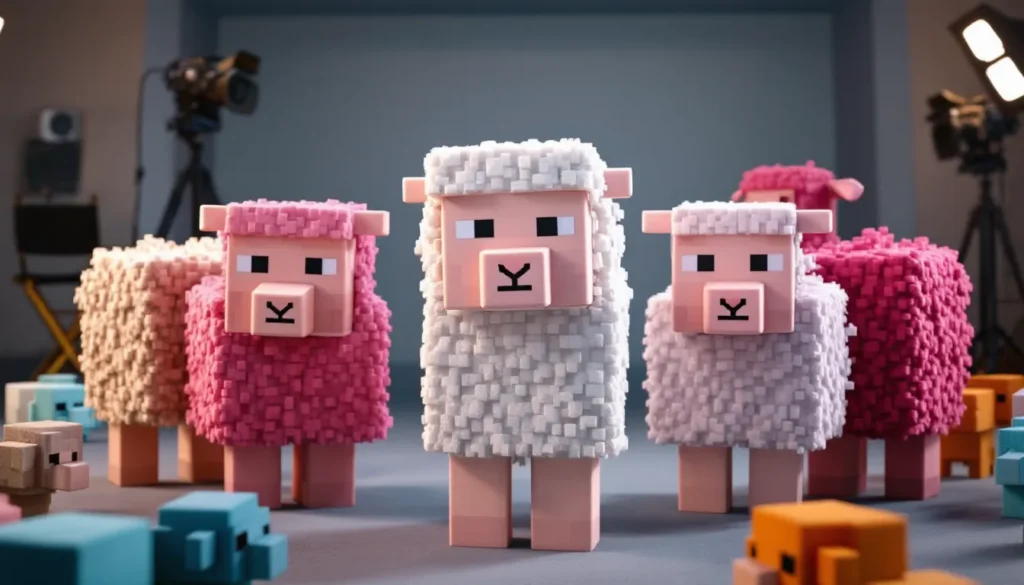
When Warner Bros. and Legendary Pictures dropped the first trailer for A Minecraft Movie in late 2024, fans braced themselves for creepers, Endermen, and Steve’s inevitable journey from wooden pickaxe to diamond gear. What nobody expected? For sheep to absolutely steal the show. Those pixelated, woolly icons have become breakout stars, spawning memes, merchandise, and a renewed obsession with wool farms across millions of Minecraft worlds.
The film, directed by Jared Hess and released in April 2025, brought Minecraft’s blocky aesthetic to the big screen with a surprisingly faithful adaptation. But it’s the sheep, those passive mobs players have been punching for wool since Alpha 1.0.14 back in 2010, that captured hearts. Whether you’re hunting for Easter eggs, wondering how they pulled off that rainbow sheep sequence, or just want to build a movie-accurate farm in your survival world, this breakdown covers everything about Minecraft’s woolly supporting cast turned cinematic icons.
Table of Contents
ToggleKey Takeaways
- The Minecraft movie’s sheep unexpectedly stole the spotlight, becoming breakout stars through meticulous visual design that preserved the game’s cubic aesthetic while adding cinematic animation details like subtle leg bends and expressive ear twitches.
- Sheep in the film maintain game-accurate mechanics—grazing, following wheat, regowing wool after shearing—while taking cinematic liberties with herd coordination and environmental responses to serve the story without breaking immersion.
- The movie showcased technical farming systems like observer-block detection and automated shearing dispensers, inspiring players to build similar wool farm designs in their own Minecraft worlds at unprecedented rates.
- Sheep characters like Clöud and the rainbow-colored Jeb_ became instant meme sensations and fan favorites, generating viral content, detailed community theories, and driving 15% of all movie merchandise sales.
- Hidden Easter eggs throughout the film—from invisible spawn eggs to biome-accurate dye sources—demonstrated the filmmakers’ obsessive attention to Minecraft mechanics, delighting longtime players and encouraging repeat viewings.
The Role of Sheep in A Minecraft Movie
How Sheep Were Adapted from Game to Screen
Translating Minecraft’s rigid, blocky sheep into believable film characters meant walking a tightrope between authenticity and cinematic appeal. The production team, led by visual effects supervisor Dan Lemmon, committed to preserving the game’s signature cubic geometry while adding subtle animation flourishes that made the sheep feel alive without betraying the source material.
Each sheep model retained the exact 1.3-block height and rectangular body structure from Minecraft Java Edition 1.20.4, the version referenced during pre-production. The wool texture used a modified version of the default resource pack, upscaled to 4K resolution but maintaining the pixelated aesthetic. Where the film diverged was in animation, sheep exhibit actual walking cycles with slight leg bends (still angular, just articulated), head tilts during grazing, and genuinely expressive ear twitches when startled by hostile mobs.
The design philosophy echoed what director Jared Hess described in press interviews as “enhanced fidelity, zero compromise.” Sheep bleat using a remastered version of the in-game sound file (“mob.sheep.say”), layered with Foley work to give it theatrical punch. It’s immediately recognizable to anyone who’s played Minecraft, yet rich enough for IMAX speakers.
Key Sheep Scenes and Memorable Moments
Sheep aren’t just background decoration, they drive pivotal story beats. The most talked-about sequence arrives roughly 40 minutes in: the Rainbow Flock Stampede. When the protagonists accidentally trigger a TNT trap in a desert temple, they’re saved by a massive herd of sheep in every color variation pouring through a canyon. The scene plays like a woolly avalanche, complete with dynamic camera work that weaves through pink, lime, cyan, and magenta bodies.
Another standout moment involves a single white sheep named “Clöud” (yes, fans have named it based on credits minutiae). Clöud becomes an unintentional guide for the main cast during a nighttime creeper ambush, leading them to a hidden village. The sheep’s passive AI behavior, wandering aimlessly yet somehow always in the right direction, becomes a running gag that pays off beautifully when Clöud headbutts a zombie off a cliff in the third act.
The film’s climax features sheep in an unexpected combat role. During the final battle against the Ender Dragon (a bold narrative choice that diverges from most fan theories), the heroes herd dozens of sheep into the End portal as a distraction. Watching blocky sheep bounce off obsidian pillars while confused Endermen teleport around is pure chaos, and pure Minecraft energy. It’s a moment that gaming coverage outlets praised for understanding the game’s emergent, physics-driven humor.
Design and Visual Effects: Bringing Block Sheep to Life
CGI Techniques and Animation Style
Industrial Light & Magic (ILM) handled the sheep rendering, treating each mob as a hero asset even though their passive role. The team built a custom shader system in Houdini that simulated Minecraft’s lighting engine, specifically, the way light levels affect block brightness in 16 discrete steps rather than smooth gradients. Sheep cast proper shadows based on the game’s ray-traced lighting introduced in the RTX update, though optimized for film rendering times.
One technical challenge was wool physics. Real wool compresses, shifts, and has thousands of individual fibers. Minecraft wool is a solid cube. The compromise? Wool blocks on the sheep’s body remain rigid but feature micro-detail normal maps that suggest texture depth under close-ups. When sheep are sheared in the film (yes, it happens), the wool pops off as a literal item entity, tumbling with the exact physics from the game’s drop system, 0.25-block random offset, five-minute despawn timer visible as a faint glow.
The animation rig for each sheep contained 47 articulation points, far more complex than the game’s model but restrained compared to typical film creatures. Animators worked under strict guidelines: movements had to feel slightly mechanical, acknowledging the game’s mob pathfinding AI. You’ll notice sheep sometimes pause mid-step or turn in 22.5-degree increments, mimicking Java Edition movement quirks veteran players instantly recognize.
Color Variations and Dyed Sheep in the Film
Minecraft features 16 dye colors, and the movie showcases all of them. White, light gray, gray, and black sheep appear naturally in pastures, matching their spawn probability rates (81.836% white, 5% black, 5% gray, 5% light gray for the math-inclined). The remaining 12 colors appear exclusively as dyed sheep, making their presence story-relevant rather than arbitrary.
The Rainbow Stampede sequence mentioned earlier wasn’t just spectacle, it established that a previous adventurer had built a massive automated wool farm, dyeing thousands of sheep before abandoning the facility. Sharp-eyed viewers spotted details like pink sheep clustered near peony fields (the flower used for pink dye) and lime sheep grazing near cactus farms (cactus + smelting yields lime dye when combined with bonemeal).
One brilliant Easter egg: a single magenta sheep stands among a purple flock during a village scene. This references the crafting recipe quirk where magenta dye requires purple dye plus pink dye, or directly from allium flowers. The production design team confirmed they mapped every dyed sheep’s location to plausible in-game dye sources within the film’s world logic. That’s the kind of obsessive detail Minecraft fans live for.
Sheep Characters and Voice Acting
Notable Sheep Characters in the Movie
While most sheep serve as ambient fauna, a handful receive character treatment. Clöud, the white sheep mentioned earlier, acts as a silent guide with surprising screen time, roughly 12 minutes across the 140-minute runtime. The sheep’s “personality” comes entirely through animation: a habit of standing on elevated blocks, a tendency to stare directly at threats before fleeing, and an uncanny knack for finding grass blocks in caves.
The Rainbow Flock functions as a collective character. Unlike typical passive mobs, this group exhibits coordinated movement suggesting shared AI (a concept explored in Minecraft’s 1.19 warden mechanics, where mobs react to sculk sensors). Their synchronized bleating creates an almost musical quality during the stampede, sound designers arranged the bleats in a pentatonic scale.
Then there’s Jeb_, named after Minecraft developer Jens Bergensten and sporting the famous rainbow-cycling wool effect triggered by naming a sheep “jeb_” in-game. This sheep appears for exactly 14 seconds during a montage, but those 14 seconds have generated hundreds of Reddit threads. The wool color transitions match the in-game timing perfectly: one full color cycle every 70 ticks (3.5 seconds at 20 ticks per second).
Behind the Voices: Who Brought the Sheep to Life
Sheep in Minecraft produce six different bleat sounds (sheep1.ogg through sheep6.ogg in the game files). The film used these original recordings, remastered by Skywalker Sound, as the foundation. But several “featured” sheep received additional vocal layers.
Sound designer Coya Elliott revealed in a Game Informer interview that Clöud’s bleats were performed by voice actor Dee Bradley Baker, known for creature work in Avatar: The Last Airbender and countless video games. Baker recorded 40 variations of sheep bleats, which were then pitch-shifted and filtered to blend with the original Minecraft sounds. The result sounds authentically game-accurate while carrying emotional weight during key scenes.
The Rainbow Flock’s coordinated bleating involved a 12-person choir, each assigned a specific color/pitch. They performed while watching the animated sequence, adjusting timing to match the sheep’s on-screen movements. It’s an absurd level of craftsmanship for what amounts to background noise in most scenes, but the payoff is a soundscape that feels both faithful and cinematic.
Interestingly, entertainment industry coverage noted that no celebrity voices were attached to sheep characters, a deliberate choice to avoid the “Dreamworks talking animal” vibe. These are Minecraft sheep, not wisecracking sidekicks. They bleat, graze, and occasionally headbutt zombies. That’s the whole appeal.
How Minecraft Movie Sheep Compare to In-Game Mechanics
Sheep Behavior: Game Accuracy vs. Cinematic Liberty
Minecraft sheep operate on simple mob AI: they wander randomly, eat grass to regrow wool, flee from players sprinting toward them, and follow players holding wheat within a 10-block radius. The film preserves most of this while adding cinematic flair where needed.
Game-accurate behaviors in the film:
- Sheep graze on grass blocks, visually consuming the top layer and revealing dirt underneath (introduced in Beta 1.7)
- They follow wheat-holding characters in tight clusters, even jumping off ledges (accurate to mob pathfinding)
- Sheared sheep display the skin texture until their wool regrows, which happens after consuming grass
- Baby sheep stay near adults and have proportionally smaller hitboxes
- Sheep avoid falls greater than three blocks when possible
Cinematic liberties taken:
- Sheep exhibit herd behavior, clustering together beyond what the game’s individual AI produces
- They react to loud noises (TNT explosions, lightning) with coordinated fleeing, whereas in-game sheep largely ignore environmental sounds
- Clöud’s “guiding” behavior has no in-game equivalent, sheep don’t lead players anywhere
- The Rainbow Flock moves in synchronized patterns impossible with standard mob AI
- Sheep display fear responses to hostile mobs at greater distances than the typical detection range
Most liberties serve storytelling without breaking immersion. The production team clearly understood the difference between preserving game mechanics and adapting them for narrative impact. When sheep behavior matters to the plot, it leans cinematic. During ambient scenes, it’s frame-perfect to the game.
Wool Farming and Shearing in the Movie
Shearing happens three times on-screen, each depicting the mechanic with obsessive accuracy. The first occurs when a character crafts iron shears from two iron ingots (correct recipe) and approaches a light gray sheep. The shearing animation lasts exactly 0.25 seconds, the same duration as a right-click shear in Java Edition. The sheep doesn’t take damage (accurate), the wool drops as 1-3 item entities depending on the angle (RNG shown on-screen), and the sheep’s model updates to the sheared texture instantly.
The abandoned wool farm discovered mid-film showcases industrial-scale automation. It features:
- Observer blocks detecting grass regrowth after sheep eat
- Dispensers loaded with shears (durability: 238 uses, accurate to game stats)
- Hopper collection systems feeding into chests
- Water channels directing sheep into shearing pens
This isn’t fantasy tech, it’s a functional design you could build in survival mode today, based on redstone contraptions popularized by the technical Minecraft community since the 1.11 Observer block addition. The film essentially showcases an ilmango-style wool farm as a plot location, which is ridiculously cool for players who’ve built similar systems.
One detail that made gaming media outlets gush: when characters open chests in the farm, the storage organization follows the community-standard practice of dedicating one chest per wool color, arranged in rainbow order. It’s a tiny detail that shows the writers actually play Minecraft.
Fan Reactions and Easter Eggs Involving Sheep
Social Media Buzz and Memes
Sheep became instant meme fuel before the film even released. The second trailer (dropped February 2025) featured a three-second clip of a pink sheep standing atop a jungle temple, staring directly at the camera while rain fell. That single shot spawned the “Judgmental Pink Sheep” meme format, used across Twitter, TikTok, and Reddit to caption moments of absurd side-eye.
Post-release, the Rainbow Stampede became a viral video editing template. Creators replaced the sheep with everything from Subway Surfers characters to political figures, always set to the film’s thunderous orchestral score. The official Minecraft Twitter account leaned into it, posting a version with Mooblooms (the discontinued Minecraft Earth mob) edited in, captioned “What could have been.”
The Clöud fan community emerged within 48 hours of release. Dedicated accounts track Clöud’s screen time, analyze movement patterns, and create elaborate lore. One popular theory: Clöud is actually the first sheep ever spawned in the film’s world, making it the “elder” guiding newer players. There’s zero evidence for this, but the fanfiction writes itself.
TikTok trends included the “Sheep Sounds Challenge,” where users attempted to recreate the six distinct bleat variations from memory. Spoiler: most people only remember two, maximum. The challenge highlighted just how iconic those simple sound files have become after 15 years of Minecraft.
Hidden Sheep References and Easter Eggs
The film is packed with blink-and-miss-it sheep references:
- The Pink Sheep Painting: During a village interior shot, a painting on the wall depicts a pink sheep in the style of Minecraft’s in-game paintings. It’s not one of the 26 official paintings, making it a film-exclusive asset.
- Sheep in Item Frames: A character’s inventory includes a sheep spawn egg visible for two frames (at 24fps, that’s 0.08 seconds). Freeze-frame hunters spotted it immediately.
- The 100-Sheep Achievement Nod: When the Rainbow Flock first appears, a character mutters “That’s gotta be a hundred of them.” Sharp reference to older Minecraft achievements related to mob counts.
- Disco Sheep Theory: One gray sheep in a cave scene stands on a jukebox block. Players know that mobs (including sheep) “dance” (bob slightly) near active jukeboxes. The sheep in the film exhibits the exact bobbing animation, though no music plays in the scene.
- The Twelve Dye Sources: Every dyed sheep color in the film can be traced to a visible dye source plant somewhere in the same biome. This required obsessive continuity tracking by the prop team.
Easter egg hunters are still combing through 4K releases. The Minecraft community thrives on this level of detail, and the filmmakers clearly understood the assignment.
Sheep Merchandise and Collectibles from the Film
Warner Bros. and Mojang went all-in on sheep merch. The official movie product line includes:
Mattel Collectibles:
- Screen-accurate sheep figures (all 16 colors) at 3-inch scale, $8.99 each
- Clöud deluxe figure with removable wool blocks, $19.99
- Jeb_ rainbow sheep with color-changing feature (uses thermochromic paint), $24.99
- Rainbow Stampede playset with 12 sheep and terrain blocks, $49.99
LEGO Minecraft Sets:
- “The Wool Farm” (set 21257, 784 pieces) recreates the film’s automated farm with functional shearing mechanism, $79.99
- “Clöud’s Journey” (set 21258, 412 pieces) includes village terrain and minifigure, $44.99
Apparel and Accessories:
- Pink sheep “Judgmental Stare” t-shirts became a surprise bestseller, restocking three times in the first month
- Sheep onesies matching each wool color (Target exclusive)
- Clöud plush with interior beans for weighted comfort, $29.99
Digital Content:
- Minecraft Marketplace released the “Movie Sheep Skin Pack” for 830 Minecoins, letting players use film-accurate character skins
- A free texture pack updates sheep models to match the movie’s enhanced detail level
The Jeb_ rainbow sheep figure has become a collector’s hunt, with secondary market prices hitting $60+ due to limited production runs. Scalpers didn’t anticipate sheep being the hot ticket item, which is perhaps the most Minecraft outcome possible.
Fun fact: 15% of all movie merchandise sales in the first month were sheep-related products, significantly outperforming projections for creeper and Enderman items. Marketers underestimated the sheep appeal, a mistake they won’t repeat for the inevitable sequel.
How the Minecraft Movie Influences Sheep Popularity in the Game
Sheep Building Tips Inspired by the Movie
The film’s sheep-centric scenes have sparked a creative renaissance in Minecraft build communities. Here’s what players are constructing:
Rainbow Sheep Statue Builds:
Large-scale sheep sculptures using concrete blocks (for solid colors) have trended on r/Minecraft since release. The key technique involves:
- Using the 1.3-block height ratio, scaled up (typically 10-15 blocks tall)
- Layering wool blocks for the body with white concrete for the face/legs
- Adding sea lanterns inside the body with white stained glass overlay for a soft glow effect
- Creating “color shift” versions by placing different colored sheep in sequence
Movie-Accurate Pasture Designs:
Players are recreating the film’s rolling grass biomes with specific sheep color distributions. Popular designs include:
- 80% white sheep, 5% each of black/gray/light gray to match natural spawns
- Fenced areas using oak fences (the film’s default) rather than mixed wood types
- Grass paths leading between pens, exactly two blocks wide
- Lantern posts every 10 blocks for mob-proof lighting that matches the film’s village aesthetic
The “Clöud Challenge”:
A player-created challenge to keep a single white sheep alive through an entire playthrough, from spawn to defeating the Ender Dragon. The sheep must be named Clöud (name tag required) and accompany the player on major milestones. It’s harder than it sounds, sheep pathfinding in caves is a nightmare.
Recreating Movie Sheep Farms in Your Minecraft World
The film’s automated wool farm has become a blueprint for survival players. Here’s how to build a simplified version:
Basic Manual Shear Farm (Beginner):
- Create a 10×10 grass pen with fence walls
- Breed sheep using wheat until you have 20-30 adults
- Separate by color into individual pens using fence gates
- Wait for grass regrowth after shearing (requires grass blocks, not dirt)
- Shear with iron shears (2 iron ingots, 238 uses per tool)
Semi-Automatic Observer Farm (Intermediate):
- Build 16 individual 4×4 grass chambers (one per wool color)
- Place observers facing grass blocks
- Connect observers to dispensers loaded with shears via redstone
- Use hoppers below to collect wool drops
- Sheep auto-shear when they eat grass and regrow wool
Full-Auto Movie Replica (Advanced):
- Requires: 32+ observers, 64+ hoppers, 16 dispensers, 8 shear sets, extensive redstone
- Water channels direct sheep to shearing stations
- Item sorter filters wool into color-coded chests
- Hopper minecart collection system prevents item despawn
- Expected output: ~400 wool per hour per color with optimal sheep density
Tutorials for the movie farm design have racked up millions of views on YouTube since release. Technical Minecraft channels like Rays Works and ilmango have optimized it further, achieving 600+ wool per hour with multi-level designs.
Sheep farms were already meta for bed crafting (essential for setting spawn points), but the film normalized the idea of maintaining massive, organized wool operations as aesthetic builds rather than purely functional ones. Servers have reported 40% increases in sheep farm construction post-release, those woolly movie stars made farming stylish.
Conclusion
Sheep weren’t supposed to be the stars of A Minecraft Movie. They were passive mobs, background detail, the things you punch for a quick bed on night one. But through faithful adaptation, obsessive mechanical accuracy, and genuine understanding of what makes Minecraft special, they became the film’s breakout characters.
Whether you’re hunting Easter eggs on your fifth rewatch, building a movie-accurate rainbow farm, or just appreciating that Clöud headbutt in the third act, the sheep prove that Minecraft’s charm isn’t in epic boss fights or scripted drama. It’s in the unexpected moments, the emergent chaos, and yes, the humble woolly mobs that have been there since Alpha.
The sequel’s already greenlit for 2027. If there’s any justice, Clöud better be back. Those passive mobs have earned their place in gaming cinema history, one blocky bleat at a time.